
Graham Jones2004 Lechner Award Recipient
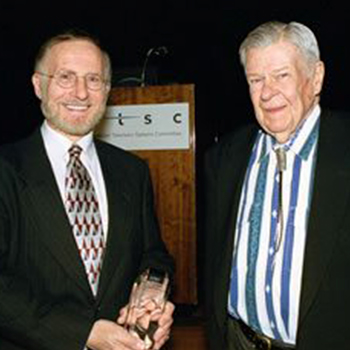
Graham Jones is Director of Communications Engineering with the Science and Technology department at the National Association of Broadcasters in Washington, DC., where he works on advanced television issues, technical standards, education and training. He is a member of the ATSC Technology and Standards Group, a member of the S6 Specialist group on Video and Audio Coding and the Systems Evaluation Working Group, and until recently was chair of the S1 Specialist Group on PSIP Metadata Communication. He is a member of the SMPTE D27 and S22 Technology Committees on Data Essence and Systems Technology and also contributes to the ITU Task Group 6/9 on Large Screen Digital Imagery.
Mr. Jones led ATSC’s efforts to develop the “Programming Metadata Communications Protocol” (PMCP) Standard. As chair of the Implementation Subcommittee PSIP Working Group, he managed the effort that identified the need for a metadata standard to facilitate communications between equipment associated with the generation of PSIP. The group developed a detailed report outlining the requirements for a standard. That report and associated IS Finding became the basis of the standardization effort in T3. Mr. Jones became chairman of the newly formed T3/S1 Specialist Group on PSIP Metadata Communication in December of 2002. T3/S1 then developed the PMCP specification which was approved and published as ATSC standard A/76 in November 2004.
Prior to joining NAB, Mr. Jones was with Harris Corporation where he was Engineering Director for the Harris/PBS DTV Express traveling road show on digital television. He started his career with the BBC in London, and for nearly twenty years with International Broadcasting Consultants worked as a consultant to broadcasters in many parts of the world.
Mr. Jones is author of the 3rd Edition of A Broadcast Engineering Tutorial for Non-Engineers and is a section-editor for the 10th Edition of the NAB Engineering Handbook. He holds a degree in Physics, is a chartered electrical engineer and a member of the IEE, SMPTE, SBE and the Royal Television Society. He is a Manager and Program Chair for the SMPTE Washington DC Section and, in 2004, received the Bernard J. Lechner Outstanding Contributor Award from the ATSC.
Subscribe to our Newsletter
Subscribe to The Standard, our monthly newsletter, to stay up-to-date with ATSC news and events around the world.