A Word from Our Sponsor: Castanet
Why ATSC 3.0 and 5G Broadcast Aren’t Rivals — And What Castanet Just Proved in Las Vegas
For most of the last five years, broadcasters and LPTV spectrum holders have been handed a false choice. Invest in ATSC 3.0, the industry’s next-generation transmission standard. Or look to 5G Broadcast, the carrier-aligned path for reaching mobile audiences at scale. Pick one.
That choice was always a strawman. At the NAB Show in Las Vegas this April, Castanet Corporation showcased the world’s first commercial-ready implementation of a Hybrid ATSC 3.0 / 5G Broadcast integration. The two standards don’t compete. They compose. And the future broadcasters have been waiting for is one that uses both.
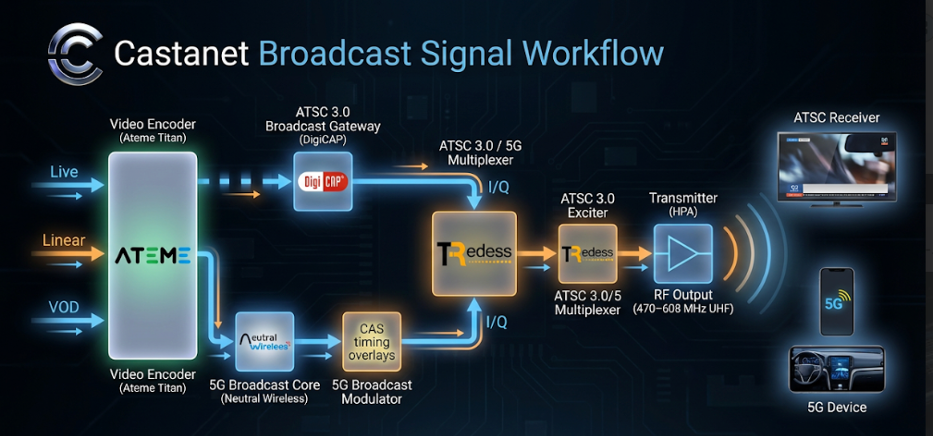
The diagram above illustrates the various elements and the Castanet technical partners, contributors and collaborators who have developed the end-to-end integration of our hybrid ATSC 3.0 + 5G Broadcast Internet solution.
The Las Vegas pilot network, with a parallel deployment in Silicon Valley with Major Market Broadcasting runs the Castanet 5G Broadcast over the ATSC 3.0 transport layer. It is not a slide deck or a lab bench. It is a working network, fully compliant with the FCC’s ‘Broadcast Internet’ rules and aligned with 3GPP Release 19. Delivering live streaming, video on demand, and AI-generated content to both fixed and mobile devices. Visitors saw what the architecture can do at this stage of its life: perfect-quality streaming with no buffering, performance that holds up where a unicast CDN would collapse, and direct delivery to mobile handsets without a SIM or a mobile carrier in the path.
That is the technical claim. The commercial claim matters more.
 Castanet’s 5G Broadcast Internet is built around the one-to-many economics broadcasters have always enjoyed but have struggled to monetize against streaming-era demand. One transmitter, every device in the contour, the same content delivered at a fraction of the cost-per-bit of any unicast alternative. Add low-latency live event internet streaming, AI-generated content, software updates, and IoT services to LPTV spectrum licensees, and the per-station math turns from defensive to offensive.
LPTV spectrum stops being a depreciating asset and starts being mission critical internet infrastructure.
The migration story is the part to which the LPTV community should pay closest attention. The Castanet model lets LPTV licensees stand up new revenue today on existing ATSC 1.0 channels using the Castanet C5G Interactive Live Sports platform in advance of the ATSC 3.0 and 5G Broadcast transition.
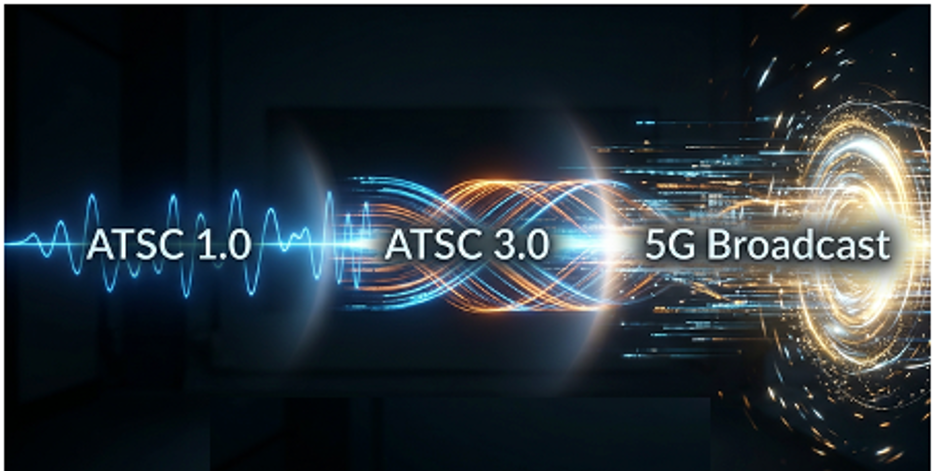
Join the Castanet 5G Broadcast Internet fabric as the consortium’s footprint grows — ultimately covering roughly 95% of the U.S. population. There is no fork in the road. The ATSC 3.0 investment is not stranded by 5G Broadcast; it is the on ramp to it.
That is the real news from NAB Las Vegas. Not a demo, not a press release — a working network and a regulatory-compliant path forward for any LPTV licensee still weighing which side of the bet to take. The answer is both.
Castanet Corporation · castanet5g.com · C5G.app
Posted in ATSC News
Subscribe to our Newsletter
Subscribe to The Standard, our monthly newsletter, to stay up-to-date with ATSC news and events around the world.