
A Word from Our Sponsor: HCLTech
From Fragmented Pipelines to Centralized Hybrid Operations
The broadcast industry has entered a period of unprecedented operational complexity. For the first time, broadcasters are simultaneously supporting legacy ATSC 1.0 services, deploying ATSC 3.0 capabilities, and expanding OTT offerings—all while maintaining the reliability and quality viewers expect. While each distribution platform introduces new opportunities, it also creates new operational silos, often resulting in separate workflows, monitoring tools, operational teams, and infrastructure supporting the same content and services. The challenge facing broadcasters today is not simply the deployment of ATSC 3.0. It is how to efficiently operate multiple delivery ecosystems concurrently while preparing for future innovation.
Historically, technology transitions in broadcasting were infrequent and largely self-contained. Today’s environment is fundamentally different. Broadcasters now operate in a world where ATSC 1.0, ATSC 3.0, OTT, and emerging services such as datacasting are expected to coexist for years. Future innovation is no longer an occasional event but an ongoing reality. Without a deliberate operational strategy, every new distribution platform introduces additional complexity, duplicated processes, fragmented visibility, and increased operational costs. As broadcasters continue to evolve their service offerings, operational agility is becoming just as important as technical capability.
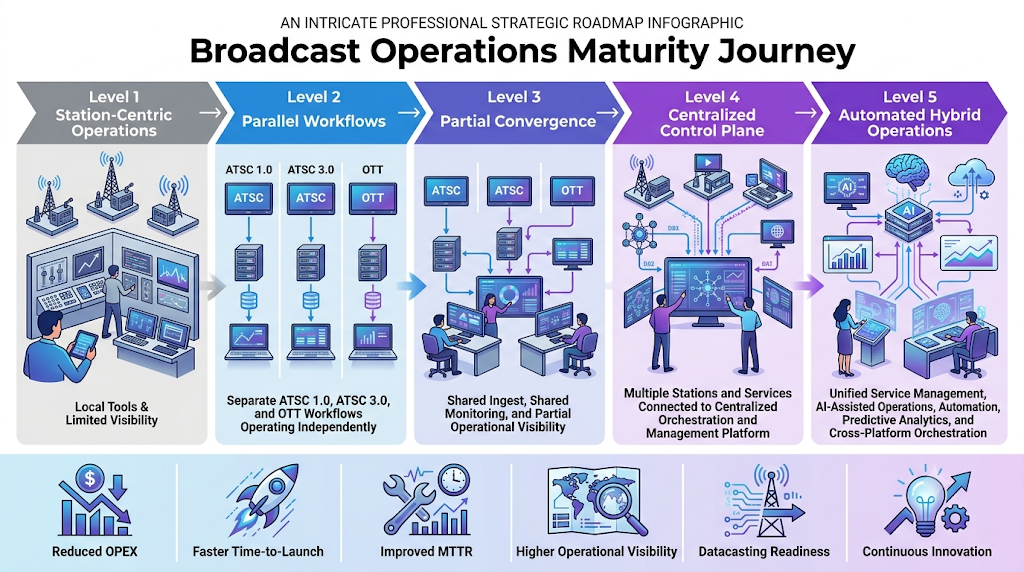
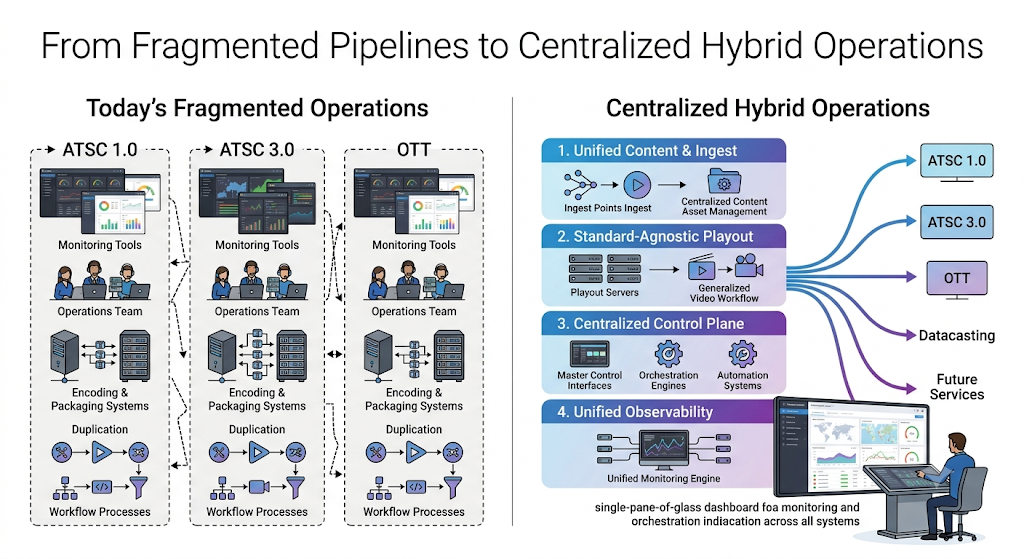
HCLTech’s white paper, From Fragmented Pipelines to Centralized Hybrid Operations, explores how broadcasters can move beyond managing individual technologies and instead adopt a service-centric operating model. The paper introduces Centralized Hybrid Operations—an approach that unifies content ingest, orchestration, monitoring, automation, observability, and service lifecycle management across ATSC 1.0, ATSC 3.0, OTT, and future delivery platforms. Rather than building separate operational environments for each transport technology, this model delivers services through a common operational framework while abstracting the underlying technology differences. By shifting the focus from transmission technologies to service delivery, broadcasters can simplify operations while preserving existing investments.
A key theme of the paper is the importance of becoming distribution-agnostic. Whether the destination is a traditional broadcast channel, an ATSC 3.0 service, an OTT stream, a datacasting application, or a future delivery platform, operators should work from a consistent set of workflows, policies, and operational processes. By normalizing around service intent rather than transmission technology, broadcasters can introduce new services without creating additional operational silos. This approach allows organizations to adapt more easily as standards, business models, and audience expectations continue to evolve.
The paper also challenges the notion that transformation requires a large-scale “rip-and-replace” initiative. Instead, broadcasters can begin with incremental steps such as unified monitoring, centralized observability, automated workflows, and shared service management. These initiatives deliver measurable business value while reducing complexity and risk. The broadcasters best positioned for success will be those that create operating models capable of supporting constant evolution. Centralized Hybrid Operations provides a practical framework for simplifying complexity, improving resilience, accelerating service deployment, and preparing organizations for the next era of broadcast, broadband, and datacasting convergence. The complete white paper also explores operational maturity models, implementation approaches, and practical strategies that broadcasters can use to gradually transform existing environments while maintaining service continuity and minimizing operational disruption.
Contact:
Atheer Sabti
Enterprise Solutions Architect
HCLTech
Posted in ATSC News
Subscribe to our Newsletter
Subscribe to The Standard, our monthly newsletter, to stay up-to-date with ATSC news and events around the world.