Someone You Should Know: Kate Riley
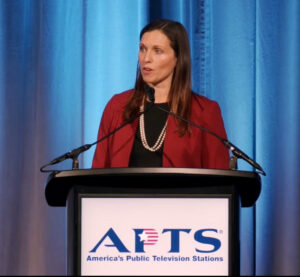 In Washington, D.C., where policy and technology often intersect, Kate Riley works at the center of an important mission: ensuring that local public television stations can continue serving communities across the United States. As President and CEO of America’s Public Television Stations (APTS), Kate represents the interests of public TV stations before Congress and federal agencies while helping station leaders navigate a rapidly evolving media and technology landscape.
Kate’s day-to-day work is deeply rooted in advocacy and connection. Much of her time is spent meeting with Members of Congress and their staff to discuss the essential services local public television stations provide, particularly in education, public safety, and community engagement. She also emphasizes the critical importance of continued federal investment so that communities everywhere, regardless of geography or how they access content, can benefit from public television’s services.
Beyond Capitol Hill, Kate maintains close relationships with station leaders across the country. Through frequent conversations, she learns about the innovative ways stations are serving their local communities and the resources they need to continue evolving in a changing media environment.
Kate first encountered ATSC 3.0 when the new broadcast standard was being developed and presented to the FCC in 2017. For public television, which has long embraced innovation to expand its public service mission, the technology immediately stood out as a natural fit. Her interest deepened in 2018 when WKAR in East Lansing, Michigan, became the first public television station to receive an experimental ATSC 3.0 license. Kate followed WKAR’s work closely, recognizing that its projects could demonstrate how the standard might benefit public broadcasting more broadly. Since then, Kate has continued to watch with enthusiasm as stations experiment with new applications. “I am continually impressed with the innovative ways that local public television stations are using ATSC 3.0 to serve their communities,” she says.
For Kate, the most exciting possibilities for ATSC 3.0 lie in its public service potential. In education, the new standard could make broadcast-based learning tools far more interactive and engaging, increasing the impact of educational media delivered through television. In public safety, the potential is even more profound. Enhanced emergency alerts and warnings can deliver highly localized information to viewers, while emerging capabilities like the Broadcast Positioning System could provide a terrestrial complement to GPS, strengthening safety and security infrastructure. Together, these capabilities highlight what Kate sees as a defining feature of public broadcasting: using technology to directly benefit communities.
When she’s not advocating for public television, Kate’s life is filled with family and activity. She and her husband have three daughters, who keep their household lively and busy. Last year the family adopted two stray kittens found on the streets of Washington, D.C. Named Ollie and Missy, the pair quickly became beloved additions to the household.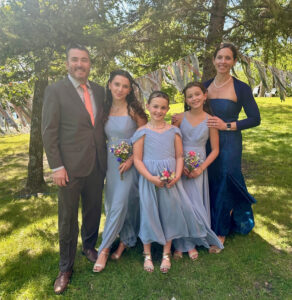
Kate also loves spending time outdoors. She enjoys skiing, rock climbing, traveling, and attending live music events. A former competitive swimmer through college, she has long enjoyed biking and has recently returned to running. After a 15-year hiatus from triathlons, Kate’s back in the sport and recently completed her first half marathon as part of her goal to finish a Half Ironman triathlon in the near future.
 Like many avid readers, Kate tends to juggle several books at once. Currently she’s listening to the audiobook of Who Is Government? The Untold Story of Public Service by Michael Lewis, which explores the work of federal employees whose contributions often go unnoticed. At the same time, Kate is reading Everything I Never Told You by Celeste Ng and Notes on Your Sudden Disappearance by Alison Espach. While the Lewis book is a bit of a departure, she says fiction is usually her preferred escape.
When it comes to television, Kate admits to having a few comfort favorites: Call the Midwife and The Great British Baking Show. More recently, she binge-watched The Pitt, and one of her all-time favorite pandemic-era binges was The Last Kingdom.
If Kate hadn’t pursued her current path, she might have thrived in the courtroom. “I think I would have made a good judge, staying calm and sifting through the facts,” she says. On the other hand, her competitive spirit might have taken her in a completely different direction: professional athletics.
Through advocacy, innovation, and a deep appreciation for public service, Kate Riley continues to help ensure that public television and the communities it serves remain strong in the digital age.
Posted in ATSC News
Subscribe to our Newsletter
Subscribe to The Standard, our monthly newsletter, to stay up-to-date with ATSC news and events around the world.