A Word from Our Sponsor: SCTE
Building the Future of Broadcast and FAST with SCTE Standards
Linear television is evolving — not disappearing.
As broadcasters, programmers, and distributors expand into streaming, FAST channels, and hybrid IP delivery, the industry faces a critical challenge: how to scale channel creation, monetization, and distribution across multiple platforms without creating fragmented workflows and costly proprietary integrations.
That challenge is exactly what the SCTE Standards Program is addressing through a growing portfolio of video technologies developed by the Digital Video Subcommittee (DVS), including SCTE 35-2, SCTE 277, and SCTE 301.
At the center of this work is SCTE 301: Next Generation Linear Channel Assembly: Scaling FAST and Other Use Cases, a recommended practice released in late 2025 that explains how existing SCTE standards can work together to support scalable, interoperable linear and streaming workflows.
Rather than introducing an entirely new technology stack, SCTE 301 demonstrates how established SCTE standards — including SCTE 35, SCTE 224, SCTE 250, and SCTE 277 — can be coordinated into a modern framework for assembling and distributing linear channels across broadcast, IPTV, CTV, OTT, and FAST environments.
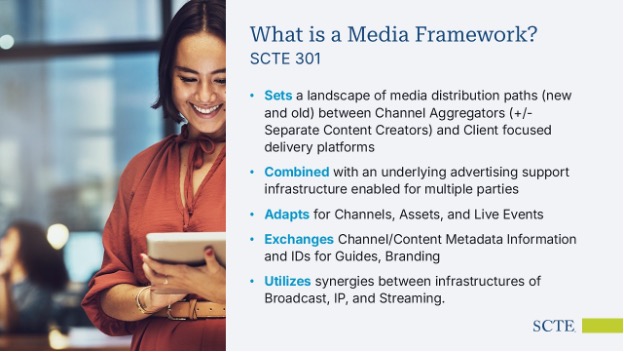
For broadcasters and programmers, this matters because FAST and streaming channel ecosystems are scaling rapidly. Channels are increasingly created from VoD libraries, dynamically updated, personalized for audiences, and distributed across multiple platforms with different technical requirements. At the same time, advertising workflows are becoming more sophisticated and increasingly dependent on precise signaling, metadata interoperability, and automation.
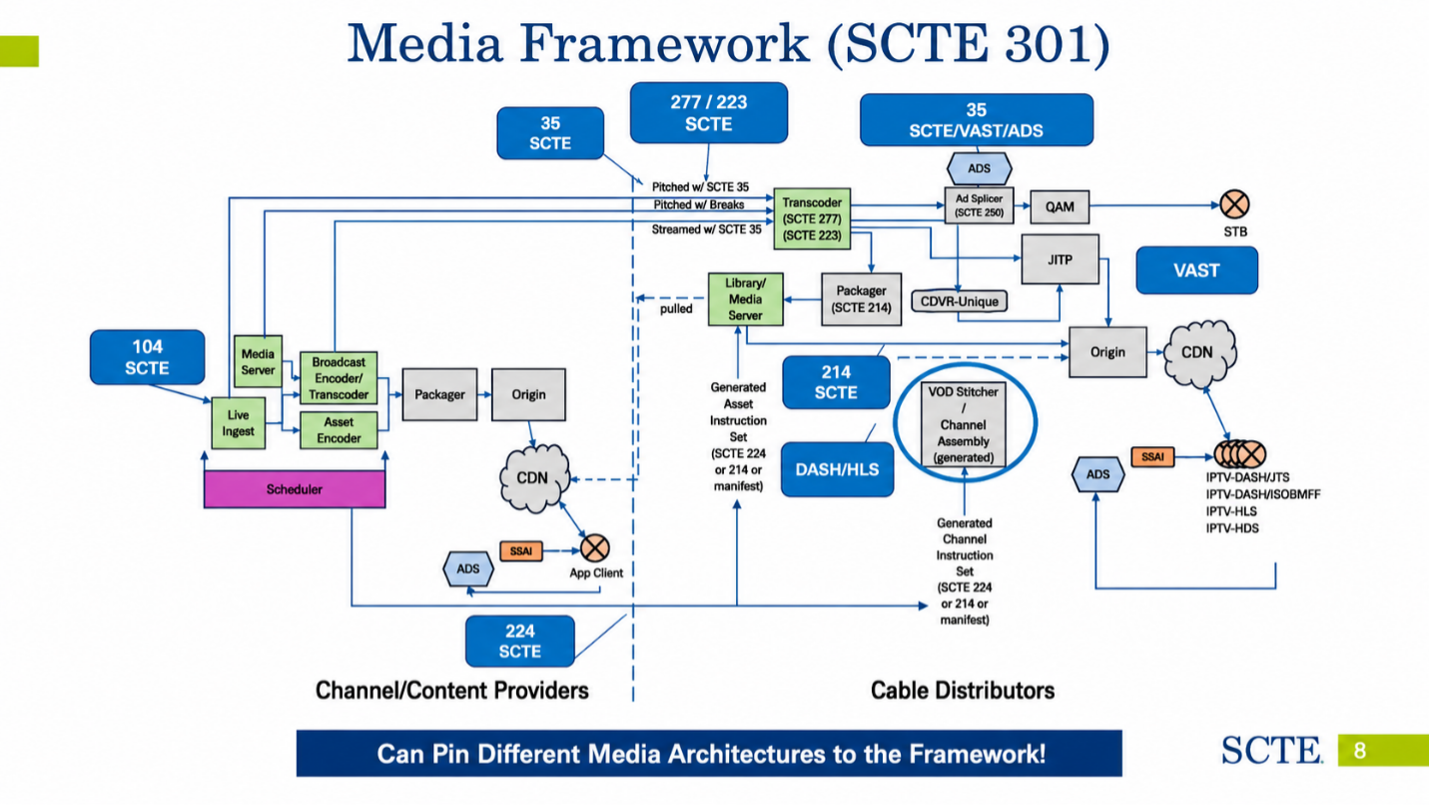
SCTE 35 remains foundational to these workflows. For more than two decades, the Emmy® Award-winning standard has enabled precise signaling of ad opportunities and content events across broadcast and streaming video environments.
Building on that legacy, SCTE 35-2 introduces a modernized event-based signaling approach designed for today’s converged broadcast and streaming ecosystem. The updated model simplifies implementation, improves interoperability, and better supports dynamic advertising, content replacement, FAST channels, and advanced streaming workflows.
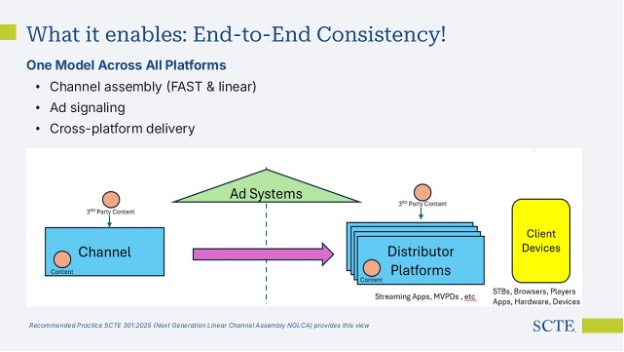
Another important piece is SCTE 277, which addresses the continued need for standardized contribution feeds between content providers and distributors. SCTE 277 establishes a common baseline for transmitting linear contribution signals across satellite, fiber, and IP infrastructures, helping broadcasters and MVPDs reduce operational complexity while supporting modern transcoding and streaming workflows.
SCTE is also collaborating with the Streaming Video Technology Alliance (SVTA) on complementary efforts focused on interoperable streaming and linear workflows. That collaboration was highlighted at NAB Show this year, where SCTE 301 and FAST channel scaling were featured in conference sessions and demonstrations within the SVTA booth.
The conversation continues this fall at SCTE TechExpo26, Sept. 29–Oct. 1, where the StreamTech program will focus on the technologies and operational strategies shaping the future of streaming, FAST, advertising, and hybrid media delivery. StreamTech sessions are designed for broadcasters, programmers, operators, and media technology teams looking to expand channel reach, improve monetization, and simplify multi-platform distribution workflows.
As the industry moves toward increasingly dynamic and streaming-centric services, standards-based interoperability is becoming more important than ever. To learn more or get involved in the SCTE Standards Program, visit scte.org/standards.
Posted in ATSC News
Subscribe to our Newsletter
Subscribe to The Standard, our monthly newsletter, to stay up-to-date with ATSC news and events around the world.